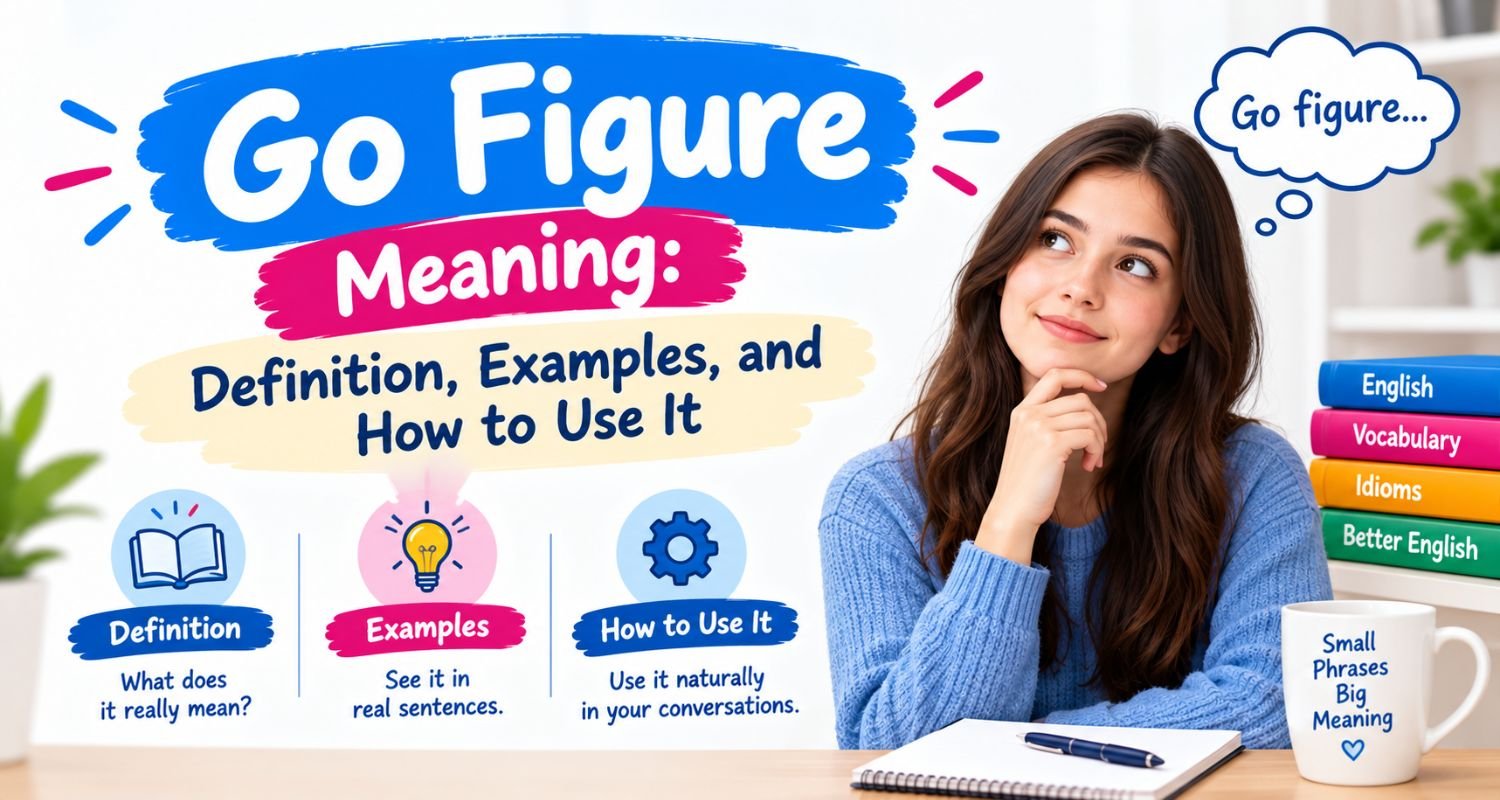
Go Figure Meaning: Definition, Examples, and How to Use It
Go figure Meaning is a common phrase you may hear in everyday conversations, but what does it really mean? Learn its definition, common uses, and examples to understand how to use “go figure” naturally in English.This quirky expression pops up in conversations when something surprising or ironic happens, often leaving us scratching our heads.
It’s a versatile phrase that captures those moments when life doesn’t go as planned but somehow still manages to make sense. In this article, we’ll break down the meaning of “go figure,” provide some relatable examples, and explore how you can use it in your everyday chats.
What Does “Go Figure” Mean? Definition, Examples & Usage
Expressions like “go figure” can often puzzle learners of English. On the surface, its literal words don’t seem to convey its conversational meaning, which is often unexpected or ironic. Used commonly in casual discussions, this phrase captures our spontaneous reactions to surprising events or outcomes.
What Is the Meaning of “Go Figure” in Simple English?
Go figure” is a phrase we use when something surprises or confuses us. It often shows that we find an unexpected twist amusing or frustrating. For example, imagine you plan a picnic for a sunny day, but it rains instead. You might say, “Go figure! I checked the weather!” It captures that feeling of disbelief about how things turned out.
The 5 Main Ways People Use “Go Figure”
1:Expressing surprise
People use “go figure” to express those little twists in life that make you chuckle. The expression hints at the irony of the situation, almost as if you’re shrugging your shoulders in acceptance. It’s a reminder that life often throws us curveballs that we can’t easily explain.
Something unexpected happened, and you honestly can’t explain it.
“I studied all night and still forgot the answer. Go figure.”
2: Unexpected Reaction
Something surprising happened that you didn’t expect.
“I studied all night, and the test was easier than I expected. Go figure.”
3: Ironic or Sarcastic Reaction
You’re reacting to something that seems strangely opposite to what was expected.
“He wanted a quiet weekend, but somehow ended up hosting a party. Go figure.”
4: Making a sarcastic or humorous comment
You’re using “go figure” to make a funny observation about an unexpected situation.
“I forgot my umbrella on the one day it decided to rain. Go figure.”
5: Reacting to something unexpected
You use “go figure” when something happens that catches you by surprise.
“I expected the movie to be boring, but I actually loved it. Go figure.”
How to Use “Go Figure” in a Sentence
When you encounter an unexpected twist in a conversation or event, the phrase “go figure” neatly captures that sense of surprise or irony. This expression often appears at the end of a sentence, providing witty punctuation to everyday moments. It’s discovering your favorite café has closed down or finding out that a friend has taken up an unusual hobby; “go figure” conveys a sense of humor or mild frustration about life’s unpredictability.
Is “Go Figure” Sarcastic?
“Go figure” can reflect genuine surprise or sarcasm, depending on the context and tone used. When someone learns that a friend forgot their coffee order yet again, they might exclaim, “Go figure!” in true disbelief, reflecting the frustration and unpredictability of the situation. This highlights a sincere reaction to consistent behavior.
How to Use “Go Figure” in Everyday Sentences
Seeing “go figure” used in everyday sentences can make it feel more familiar and conversational. Here are some examples that illustrate its versatility:
1. My cat, who loves to hide, decided to sit right in front of the window. Go figure.
2. Janet studied all night for her test and still didn’t pass. Go figure.
3. The forecast said rain, but it turned out to be the sunniest day of the week. Go figure.
4. After weeks of stressing over the project, Sam completed it in just one afternoon. Go figure.
5. The expensive blender I bought didn’t work, while the cheap one from the thrift store is still going strong. Go figure.
6. I lost my phone in the house and found it in the fridge. Go figure.
7. My reliable car broke down right before our road trip. Go figure.
8. The overpriced coffee shop had a line out the door, while the little café next door was empty. Go figure.
9. Tom always forgets his lunch, yet today he remembered three times. Go figure.
10. She finally decided to try yoga and ended up being the best in the class. Go figure.
11. The event sold out fast, yet we bumped into several empty seats. Go figure.
12. Just when I thought I’d mastered the recipe, it turned out completely bland. Go figure.
Each of these examples highlights an unexpected or ironic twist, perfectly setting up the phrase “go figure.” It adds a light-hearted touch to moments we didn’t see coming, showcasing how life can surprise us all.
“Go Figure” in Lifestyle Conversations

“Go figure” often pops up in conversations as a quick reaction, perfectly capturing a mix of surprise or irony without the need for lengthy explanations. It’s a handy phrase that encapsulates how life can throw us curveballs.
“Did you hear Jake got fired for being late again?”
“Yeah, go figure. You’d think he’d learn.”
“Emma won the lottery after only buying one ticket!”
“Go figure. She never even plays!”
“You wouldn’t believe I spilled coffee on my presentation.”
“Go figure. Just your luck!”
*Texting*: “Lost my wallet today; turns out it was under my couch.”
“Go figure! That’s classic you.”
In these snippets, “go figure” efficiently conveys disbelief, highlights ironic twists, or emphasizes frustration. It’s a reminder that life’s surprises can be both amusing and bewildering, perfectly encapsulating complex feelings with just two words.
Go Figure Meaning in Different Contexts
In casual conversations, “go figure” often reflects mild surprise, suggesting that the speaker finds something unexpected but not overly shocking. For instance, if a friend discovers that a notoriously lazy coworker completed a big project on time, they might say, “Go figure!” This shows a hint of disbelief paired with light humor.
Go Figure vs. Other Similar Expressions
“Go figure” is often confused with a few other everyday expressions. Although they can all describe surprise, agreement, or irony, each phrase has a slightly different meaning and tone.
| Expression | Meaning or Tone | Example |
| Go figure | Unexpected or ironic reaction | “The bus arrived early for once. Go figure.” |
| It figures | Something predictable | “Of course my phone died today. It figures.” |
| No kidding. | Agreement or genuine surprise | “She finished the project in one day.” “No kidding!” |
| Duh | Something obvious | “You need a ticket to enter.” “Duh.” |
| Who knew? | Lighthearted surprise | “He turned out to be a great cook. Who knew?” |
The main difference is simple: “It figures” suggests that something was expected, while “go figure” usually highlights something surprising, ironic, or unexpected.
Is “Go Figure” Formal or Informal? Where to Use It
“Go figure” is primarily informal English, making it perfect for casual conversations. When chatting with friends or texting, this phrase flows naturally. For instance, you might say, “She won the contest again, go figure!” on social media to express surprise. However, using it in a workplace meeting or a professional email might feel out of place, as it doesn’t fit the serious tone often required.
Here’s a quick guide to where you can use “go figure”:
Casual conversations: Yes, it sounds natural in everyday speech.
Text messages and social media: Yes, it fits informal online communication.
Friendly workplace chats: Usually acceptable when the tone is casual.
Formal emails: Better to use a more neutral expression.
When Should You Use Go Figure?
“Go figure” is perfect for those moments when life throws you a curveball. When your friend finds a way to win a game they didn’t even practice for, you might chuckle and say, “Go figure.” It captures the irony of an unexpected victory. Similarly, if your coworker is late because their car broke down, and it’s the third time this month, you could shake your head and say, “Go figure,” reflecting mild frustration.
Smart Fixes for Common English Mistakes
“Go figure” is a fun phrase that expresses surprise or disbelief. However, many English learners stumble when using it. Here are some common mistakes to watch out for:
Don’t take it literally. It’s not an instruction to calculate something, but a way to say “can you believe it?”
Avoid using it in formal writing. Stick to more formal phrases in professional emails or academic papers.
Don’t place it awkwardly in a sentence. Ensure it fits smoothly into your dialogue for clarity.
Avoid assuming its tone is always casual. The context matters; it can sound sarcastic or humorous depending on how you use it.
Examples:
❌ “I didn’t study, and I passed the exam. Go figure, it was easy.”
✅ “I didn’t study, and I passed the exam. Go figure! It was easier than I thought.”
❌ “The meeting was canceled last minute, go figure.”
✅ “The meeting was canceled last minute. Go figure.”
Remember, “go figure” is casual and generally harmless. Use it with confidence!
Why Do People Say “Go Figure”?
The exact origin of the phrase “go figure” remains a bit of a mystery, with several theories floating around that suggest different pathways to its current usage. It’s important to treat these theories as possibilities rather than confirmed facts.
One interesting theory points to a Yiddish influence. The phrase “gey vays,” which translates to “go know,” carries a similar essence of irony or surprise. This connection hints at how immigrant cultures may have melded their languages with English, enriching it in playful ways.
Another suggestion is that “go figure” emerged as a shortened form of “go figure it out.” Over time, people may have adopted the catchphrase to express disbelief or confusion without needing to complete the fuller expression. This usage emphasizes the casual tone we often hear today.
Is go figure used in British, Canadian & Australian English?
The phrase “go figure” is primarily linked to North American English, but its usage has spread to other English-speaking regions. In the UK, Canada, and Australia, people generally understand the expression, though it might not feel as natural for everyone. While some may use it casually, others might find it less common in their daily conversations.
In Canada, a speaker might say, “He got a raise after a bad review — go figure.”
In the UK, you could hear, “She forgot my birthday again, go figure.”
Australians might use it informally: “The train was late again, go figure.”
Overall, it thrives in relaxed spoken language and social media where informal expressions are the norm.
Conclusion
Go figure is a versatile phrase that conveys surprise or disbelief in various contexts. Its tone can shift based on the situation, whether you’re expressing sarcasm or genuine astonishment. You’ll find it often in everyday conversations, making it a handy expression to enrich your informal speech.
Although the exact origin of “go figure” is unclear, its informal nature is widely recognized. With this understanding, you can confidently incorporate “go figure” into your conversations, adding a touch of relatable expression when the moment calls for it.