

Science Words That Start With J: Key Terms and Their Importance in Modern Science
Science Words That Start With J terms can make a familiar topic harder to follow when their meanings are unclear. Words beginning with J appear across disciplines, from biology and chemistry to physics and environmental science.
A joule, for example, is a unit of energy used to describe work and heat, while a jet stream is a fast-moving current of air that influences weather patterns. Other J terms help name processes, structures, and measurements scientists use to describe the natural world. Learning these words builds scientific vocabulary and makes it easier to follow explanations, interpret evidence, and connect ideas across fields.
List of science words that start with J
- Joule
- Jet stream
- Jupiter
- Jurassic
- J-carve
- Joule-thomson effect
- Joints
- Joule per second
- J-integral
- j-protein
Also Read: NTM Meaning Slang: What Does NTM Mean in Texting & Social Media?
Joule (J)
The joule (J) is the SI unit of energy and work. One joule of work occurs when a force of one newton moves an object one meter in the direction of that force. This definition connects energy to a measurable change in an object’s motion or position.
Joules are also used to describe energy in electricity and heat transfer. For example, electrical energy supplied to a device and heat transferred to a material can both be measured in joules. In mechanics and thermodynamics, the unit helps quantify work and energy changes in systems, making it useful across many areas of physics.
Jet stream
A jet stream is a narrow band of fast-moving winds high in Earth’s atmosphere, generally near the tropopause the boundary between the troposphere and stratosphere. These winds form in part because of temperature contrasts between air masses, while Earth’s rotation helps shape their movement.
Jupiter
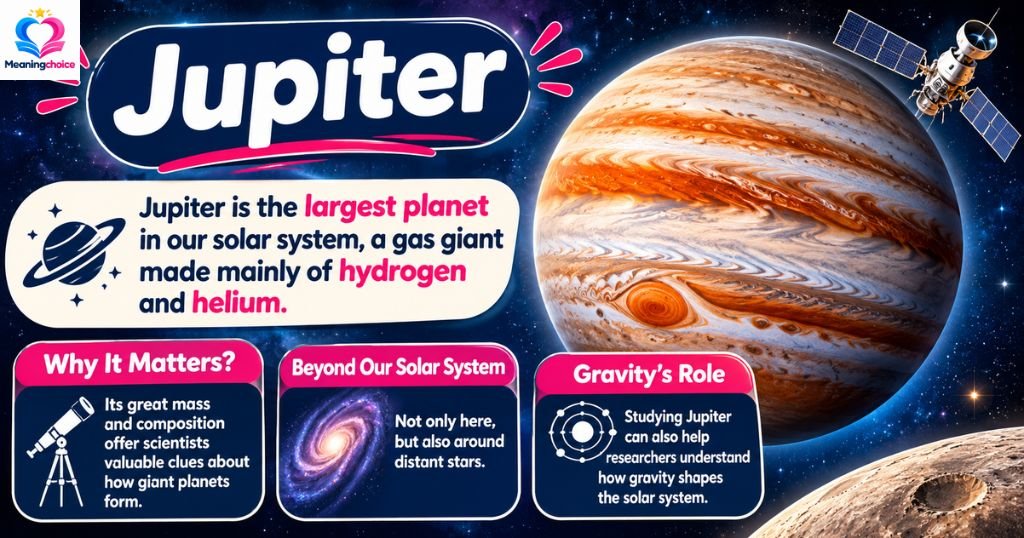
Jupiter is the largest planet in our solar system, a gas giant made mainly of hydrogen and helium. Its great mass and composition offer scientists valuable clues about how giant planets form not only here, but also around distant stars. Studying Jupiter can also help researchers understand how gravity shapes the solar system.
Jurassic
The Jurassic Period, which lasted from about 201 to 145 million years ago, was a time of major change across Earth. As the supercontinent Pangaea continued to break apart, new ocean basins formed and habitats shifted. Widespread vegetation supported a diversity of dinosaurs, including Brachiosaurus, Stegosaurus, and Allosaurus.
J-Curve
A J-curve describes a pattern in which a measured value rises slowly at first, then increases more rapidly. When plotted on a graph, this accelerating rise resembles the letter J. The term appears in fields including biology, economics, population studies, and environmental science, though its specific meaning can vary by context.
Joule-Thomson Effect
The Joule-Thomson effect describes the temperature change that occurs when a real gas expands from high to low pressure while its enthalpy remains constant. In practice, this often happens as gas passes through a throttling device, with little heat exchanged with its surroundings. Depending on the gas and its starting temperature, the expansion can cause the gas to cool or warm.
Joints (Anatomy)
Joints are the places where two or more bones connect. Some mainly provide stability, while others allow movement in specific ways: hinge joints bend and straighten, ball-and-socket joints move through a wider range, and pivot joints allow rotation.
Joule per Second (Watt)
A joule per second, called a watt (W), is the SI unit of power. It describes how quickly energy is transferred or work is done: one watt equals one joule per second (1 W = 1 J/s). While energy measures an amount, power indicates the rate at which that energy is used or delivered.
J-Integral (Fracture Mechanics)
The J-integral is a fracture-mechanics measure used to describe the conditions near a crack in a material. By quantifying the stress intensity around the crack, it helps engineers assess how a material may respond to pressure and predict when failure could occur.
That insight informs the design of structures, bridges, aircraft, and machinery, where understanding crack growth is important to safety. The J-integral also helps scientists study how materials behave under stress and supports research into stronger, more durable materials work that connects fracture mechanics to materials science and industrial design.
J-Protein (Biology)
J-proteins, also called Hsp40 proteins, help cells manage protein folding by working closely with Hsp70 proteins. They assist newly formed or damaged proteins as they take on the shapes needed to function, helping prevent proteins from clumping together in harmful ways.
This partnership is especially important during heat shock and other environmental stresses, when proteins are more likely to become damaged or misfolded. By supporting the cell’s response to these challenges, J-proteins contribute to cellular health. Researchers study their role to better understand diseases associated with protein misfolding, including neurodegenerative disorders, making them important subjects in molecular biology, genetics, and medical research.
Also Read: EMP Meaning in Text from a Girl: What It Really Means and How to Understand It
Final Thought
J-terms demonstrate how specialized vocabulary helps explain ideas across fields, from energy and weather to living systems and Earth processes. To make these concepts stick, choose a few unfamiliar terms, look up their definitions, and use each in a sentence about the science it describes.