
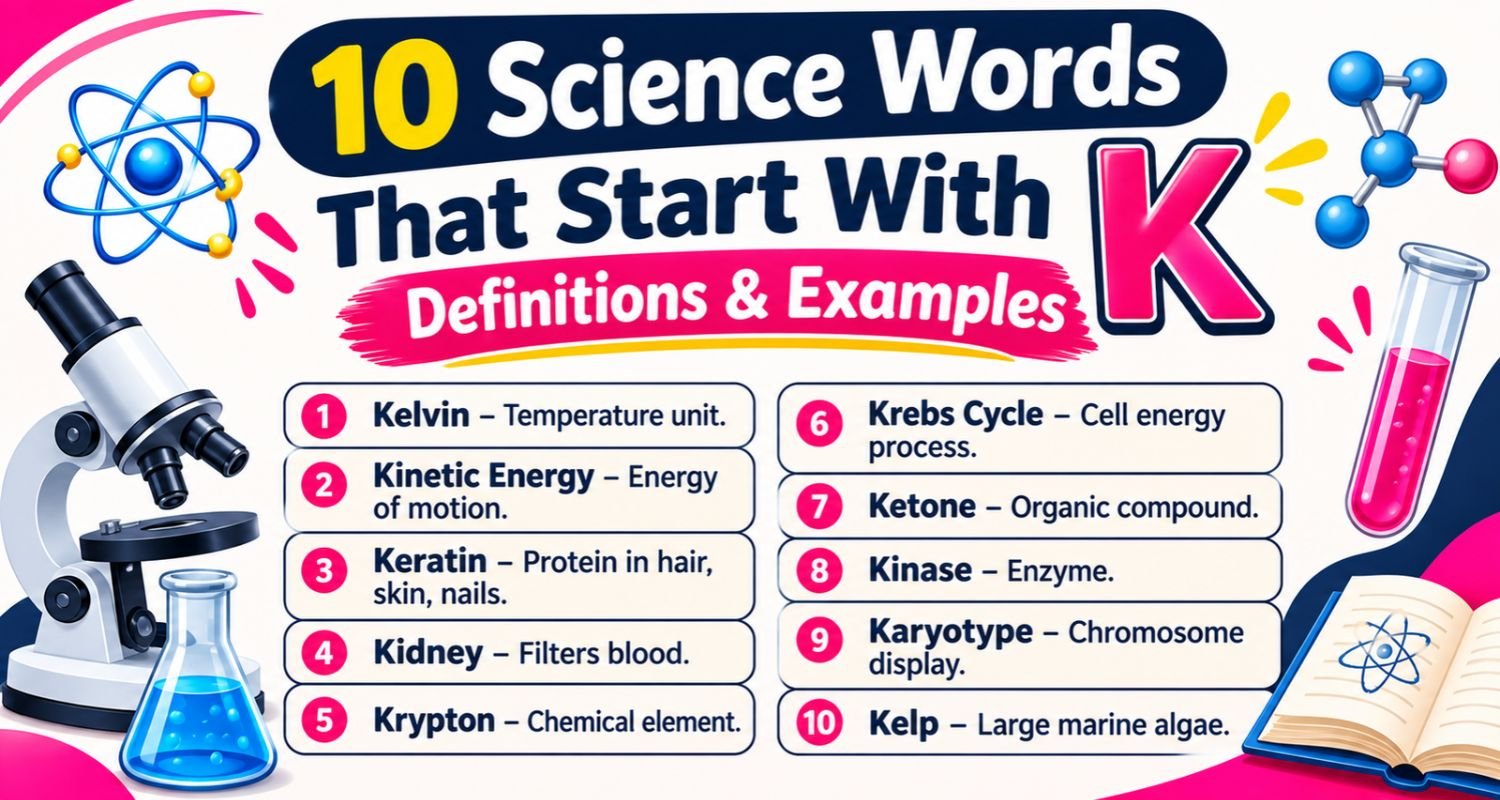
10 Science Words That Start With K Definitions & Examples
Scientific vocabulary makes unfamiliar ideas easier to understand, and terms beginning with K appear across many branches of science. In biology, “kingdom” helps classify living things; in physics, “kinetic energy” describes energy of motion; and in measurement, “kelvin” is the standard unit of temperature used in scientific work.
Learning these words gives students and teachers clearer ways to explain key concepts, helps researchers communicate precisely, and gives curious readers a stronger foundation for exploring science. This guide to science words that start with K introduces useful terms from biology, chemistry, physics, astronomy, and other disciplines. Each word comes with a simple definition and an explanation of how it is used in science.
List Of Science Words That Start With K
- Kelvin
- Kinetic energy
- Karyotype
- Kilogram
- Karyoplasim
- Kymograph
- Krebs cycle
- karyokinesis
- Kymography
- keratin
Kelvin
The kelvin (K) is the SI unit of thermodynamic temperature. Its scale begins at 0 K, called absolute zero the lowest temperature possible. At this limit, a system has its minimum thermal energy, but that does not mean all molecular motion completely stops. Using a scale that starts at absolute zero makes temperature relationships in scientific equations more direct.
Scientists use kelvin in physics, chemistry, and thermodynamics, including gas-law calculations, where temperature must be expressed on an absolute scale. Astronomers use it to describe stars and other objects in space, while blackbody-radiation studies and low-temperature experiments also rely on kelvin. For example, a room at 20°C is 293.15 K, using the conversion K = °C + 273.15. This helps beginners compare familiar temperatures with scientific measurements. Because kelvin values do not shift below zero, researchers can compare laboratory results and space observations consistently and use them reliably in calculations.
Kinetic Energy
Kinetic energy is the energy an object has because it is moving. The amount depends on the object’s mass and velocity: a heavier object has more kinetic energy at the same speed, while a faster object has much more. The standard formula is KE = ½mv², where KE means kinetic energy, m is mass, and v is velocity. Because velocity is squared, doubling an object’s speed makes its kinetic energy four times greater. For example, a bicycle moving twice as fast as before has four times as much kinetic energy if its mass stays the same.
Karyotype
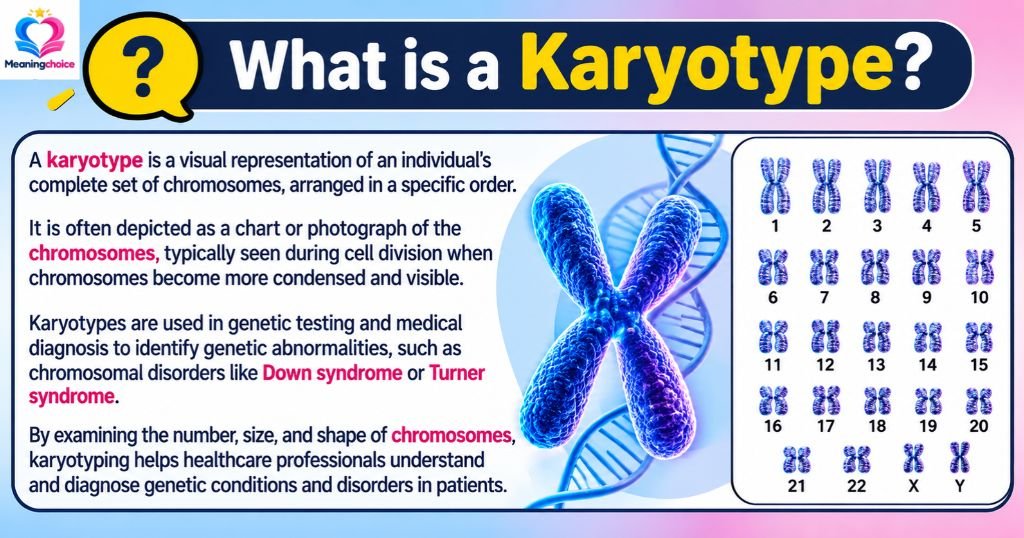
A karyotype is an organized visual display of a person’s chromosomes, arranged in pairs by size, shape, and features such as the position of the centromere the point where each chromosome is pinched. Most human body cells contain 46 chromosomes: 22 pairs of autosomes, which are not sex chromosomes, and one pair of sex chromosomes. To make a karyotype, laboratory workers typically encourage cells to divide, stop them when chromosomes are tightly condensed, stain the chromosomes, and photograph them under a microscope.
They then arrange the images into matching pairs for examination. This view can reveal changes in chromosome number or structure. For example, three copies of chromosome 21 indicate Down syndrome, while a missing or altered sex chromosome can be associated with Turner syndrome. Karyotyping can support prenatal diagnosis, help researchers study chromosome changes in cancer, and allow comparisons among species in evolutionary biology. The term karyotype refers to the display or complement of chromosomes; karyotyping is the laboratory process used to examine and organize chromosomes.
Kilogram
The kilogram (kg) is the SI base unit of mass: it tells how much matter an object has and is used in physics, chemistry, engineering, medicine, and daily life. A one-kilogram bag of sugar, for example, has a mass of 1 kg. Since 2019, the kilogram has been defined by fixing the numerical value of the Planck constant, a fundamental quantity in quantum physics. By linking mass to this constant through precise experiments, scientists can establish a standard that does not depend on a single object and can be reproduced in laboratories.
Before 2019, the standard was a cylinder made of platinum and iridium called the International Prototype of the Kilogram. Mass is not the same as weight: mass is measured in kilograms, while weight is the force of gravity on an object and is measured in newtons. Kilograms support careful laboratory experiments, chemical measurements, pharmaceutical production, material science, and calculations of forces acting on objects.
Karyoplasm
Karyoplasm, also called nucleoplasm, is the semi-fluid, gel-like material inside a cell’s nucleus. It surrounds and supports structures such as chromatin, the DNA and proteins that make up chromosomes, and the nucleolus, where components of ribosomes are produced. Karyoplasm contains mostly water, along with proteins, enzymes, nucleotides, ions, and other dissolved molecules that help maintain conditions inside the nucleus.
These materials enable essential activities: enzymes and nucleotides help copy DNA and transcribe it into RNA, while the nucleolus uses RNA and proteins to assemble ribosome components. By providing a setting for these processes, the karyoplasm contributes to gene expression, the use of genetic instructions to make functional products. During cell division, nuclear structures reorganize as chromosomes are prepared for distribution to new cells; the nuclear environment helps support their organization before the nucleus changes and later reforms. Studying karyoplasm therefore helps researchers understand how genes function, how cells reproduce, and how molecular activities are coordinated within the nucleus.
Also Read: Science Words That Start With J: Key Terms and Their Importance in Modern Science
Kymograph
A kymograph is a scientific recording instrument historically used to make a graphical record of movement, pressure, or another physical variable as it changes over time. In a traditional model, a sheet of paper is wrapped around a drum that rotates at a steady rate. A recording stylus rests against the paper and moves in response to the activity being measured, drawing a continuous line as the drum turns. The line’s shape and position show how the measurement changes, while its progress along the paper represents time.
Researchers could use these traces to compare events, such as the strength and timing of muscle contractions or changes in blood pressure. In physiology, kymographs also recorded heartbeat-related activity and respiratory movements, helping scientists investigate how muscles, organs, and other biological systems function. Many laboratories now use electronic sensors and digital recording systems instead. Although the equipment has changed, the underlying principle remains: measure an activity and record its changes over time.
Krebs Cycle
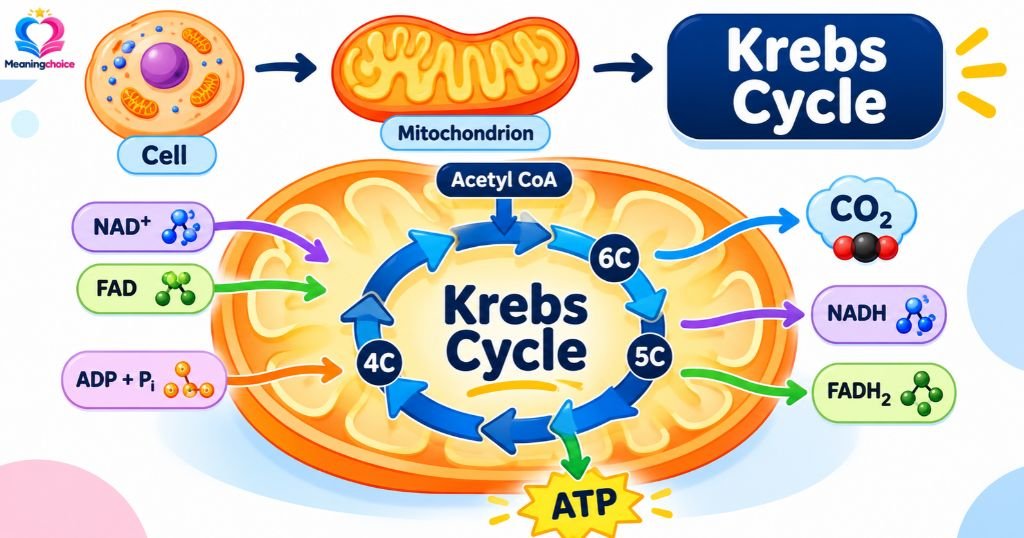
The Krebs cycle, also called the citric acid cycle or tricarboxylic acid (TCA) cycle, is a central stage of aerobic cellular respiration, the process cells use to release energy from nutrients. In eukaryotic cells, it takes place mainly in the mitochondrial matrix, the compartment inside the mitochondrion. Each round begins when acetyl-CoA, a two-carbon molecule made as nutrients are broken down, joins oxaloacetate to form citrate. A series of chemical reactions then releases carbon dioxide and captures energy in carrier molecules, eventually regenerating oxaloacetate so the cycle can begin again.
Karyokinesis
Karyokinesis is the division of a cell’s nucleus during cell division. It distributes duplicated genetic material, the DNA packaged into chromosomes, into daughter nuclei. During mitosis, this helps ensure that each new nucleus receives a set of chromosomes. The process is commonly described in four stages: in prophase, chromosomes condense and become visible; in metaphase, they line up near the cell’s center; in anaphase, sister chromatids (matching copies of a chromosome) separate and move toward opposite poles; and in telophase, new nuclear envelopes form around the two chromosome sets.
Kymography
Kymography is a recording technique that makes a graphical trace of movement, pressure, or another measurable physical activity over time. The technique is not the same as a kymograph: kymography is the process, while a kymograph is the traditional instrument used to record it. In a common setup, a rotating drum carries paper or another recording surface. A stylus connected to the activity being measured moves against that surface, leaving a continuous line as the drum turns.
Researchers read the trace to compare when changes occur, how strong they are, and what patterns repeat. In physiology, kymographs helped scientists record muscle contractions, variations in blood pressure, and breathing movements. Adapted recording arrangements also captured sound vibrations and other physical signals. Today, electronic sensors and digital systems perform many similar monitoring tasks, often with more flexible ways to store and analyze data. Modern biomedical monitoring grew through many advances, however, and should not be treated as a direct product of kymography alone.
Keratin
Keratin is a tough, fibrous structural protein found in human hair, nails, and the outer layer of the skin. It also forms animal structures such as feathers, claws, horns, and hooves. Its strong fibers help these tissues resist everyday wear and physical damage, while the outer skin layer helps protect the body.
Also Read: CBFW Meaning in Text: Full Form, Slang Examples & How to Use It
Final Thought
Learning science words that start with K reveals how a single letter can open doors to many fields. A kilogram measures mass, while a kelvin expresses temperature; kinetic energy describes motion. In biology, a karyotype organizes chromosomes, karyokinesis names a stage of cell division, and the Krebs cycle helps explain how cells process energy. Knowing these terms helps students follow lessons, gives teachers clear language for explaining ideas, and lets curious readers make sense of science in everyday life. Keep a vocabulary notebook and add new terms as you explore the world of science.