
Pre and Post Meaning: Understanding Their Usage and Importance
Pre and Post Meaning: Many people don’t realize that the prefixes “pre” and “post” can dramatically change the meaning of everyday words. Understanding “pre” and “post” is important not just for language lovers but for anyone looking to communicate more effectively in casual and professional settings. “Pre” typically refers to something that occurs before an event, while “post” indicates something that happens afterwards.
“pre-flight” checks ensure everything is in order before takeoff, while “post-event” reports help assess what happened after a gathering. This article will clarify these prefixes, along with examples, empowering you to use them accurately in your conversations and writing.
What Does Pre Mean?
The prefix “pre” stems from Latin and translates to “before.” It serves as a versatile marker in the English language, indicating that something occurs earlier in time or in advance. For example, “preview” suggests viewing something before its official release, while “preheat” means warming an oven before cooking.
For example:
- Preheat—To heat an oven before cooking.
- Prepay—To pay for something in advance.
- Preview—To see something before its official release.
What Does Post Mean?
The term “post” originates from the Latin word “post,” which translates to “after” or “following.” This prefix is often used to indicate a sequence in time.”post-game” refers to events or discussions that occur after a game has concluded. This usage clearly illustrates how the prefix denotes a period that follows an event.
For example:
- Postpone—To delay an event or activity to a later time.
- Postgraduate – A level of education that comes after completing a basic degree.
- Postmortem—An examination that occurs after death.
Importance of Pre and Post
“Pre” means before, while “post” means after. These terms are commonly used in educational contexts, particularly when discussing assessments like pre-tests and post-tests. A pre-test is administered prior to a lesson or unit to gauge students’ existing knowledge and pinpoint areas that need focus. This initial assessment can help educators plan instruction based on students’ existing knowledge.
Pre and Post Meaning in Daily Life
The prefixes pre- and post- appear in many words we use in everyday conversations, work, school, travel, and technology. In most cases, pre refers to something that happens before an event or action, while post refers to something that happens after it.
Understanding these two prefixes can make unfamiliar words easier to understand. For example, if something is described as pre-event, it takes place before the event. If it is post-event, it happens after the event has finished.
Examples of Pre in Daily Life
The prefix pre- is used when something is done, prepared, or arranged before another action or event. Here are some common examples:
- Preheat: You preheat an oven before putting food inside so it reaches the required temperature.
- Prepay: You prepay when you make a payment before receiving a service or using it.
- Preview: A preview lets you see part of a movie, show, book, or product before the full release.
- Preplan: You preplan your day when you decide in advance what tasks you want to complete.
- Prewash: Prewashing means washing clothes or another item before the main cleaning process.
- Pre-book: You pre-book a hotel, flight, or ticket before the date you actually need it.
- Pretest: A pretest checks what students already know before a lesson or course begins.
- Pre-cut: Pre-cut vegetables or other ingredients have already been cut before you begin cooking.
- Prepack: You prepack your belongings when you put them together ahead of a trip or event.
- Preprogram: A device can be preprogrammed to act automatically at a set time.
- Pre-order: You pre-order a product when you purchase or reserve it before it officially becomes available.
- Pre-exercise: Pre-exercise activities, such as light movement or stretching, are completed before a workout.
- Pre-read: You pre-read material when you look through it before attending a class, meeting, or presentation.
- Pre-screen: Employers may pre-screen applications or candidates before conducting full interviews.
- Pre-schedule: You can pre-schedule social media posts so they are published at a chosen time later.
- Pre-install: A phone or computer may come with certain apps pre-installed before you start using the device.
- Pre-fill: A form is pre-filled when some information has already been entered before you submit it.
- Pre-clean: Pre-cleaning a surface means removing dirt or dust before painting, repairing, or applying another product.
- Pre-chill: You pre-chill drinks by placing them in a refrigerator before serving them.
- Pre-record: A video, presentation, or message is pre-recorded when it is created before it is shown or shared.
Examples of Post in Daily Life
The prefix post- generally describes something that happens after an event, activity, or process. These words are common in work, education, health, entertainment, and everyday routines.
- Postpone: To postpone something means to move it to a later time or date.
- Post-workout: A post-workout meal or drink is consumed after exercising.
- Post-event: Post-event activities, such as collecting feedback, take place after an event ends.
- Post-call: Post-call notes are written after an important phone or business call to record what was discussed.
- Post-graduation: Post-graduation plans describe what someone intends to do after finishing their studies.
- Post-release: A post-release review is published after a movie, product, game, or software update becomes available.
- Post-payment: A post-payment confirmation is received after a payment has been completed.
- Post-surgery: Post-surgery care refers to the treatment, rest, and instructions followed after an operation.
- Post-reading: Post-reading activities are completed after reading to help review or understand the material.
- Post-vacation: Post-vacation tasks include things such as unpacking, doing laundry, and organizing belongings after returning home.
Easy Way to Remember Pre and Post
A simple way to remember the difference is:
Pre = Before
Post = After
For example, pre-event preparation happens before an event, while post-event feedback happens after it. Once you understand this basic pattern, many words containing pre- and post- become much easier to understand.
Pre and Post Meaning in Education
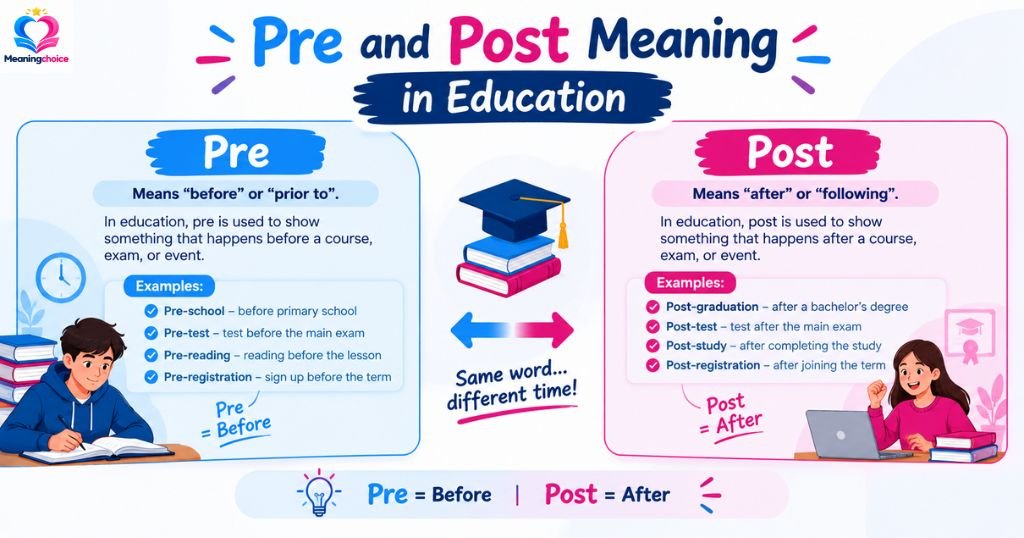
“Pre” refers to the time before an event or action, while “post” signifies the time afterward. In educational contexts, these terms are commonly used in assessments and activities to measure changes over time.
– Pre-test: Conducted before instruction begins, it evaluates students’ prior knowledge, providing a baseline for comparison.
– Post-test: Administered after teaching, it assesses what students have learned and how well they have grasped the material.
– Pre-reading: Activities or strategies applied before reading a text can help activate background knowledge and set a purpose for reading.
– Post-reading: Activities that take place after reading can help reinforce comprehension and facilitate reflection on the material.
Pre- and Post-Meaning in Business
Businesses often use pre and post in planning, finance, and operations.
Pre-Examples in Business
Here are some common business terms that use the prefix pre-:
- Pre-launch: Pre-launch activities are completed before a product, service, or business officially launches. They may include testing, marketing, market research, and preparing promotional materials.
- Pre-tax: Pre-tax refers to income, profit, or an amount calculated before taxes are deducted. For example, a salary may be described as pre-tax income before applicable taxes are taken out.
- Pre-approval: Pre-approval means receiving an initial approval before completing a transaction or taking a particular business action. It is commonly used in lending, purchasing, and business processes.
- Pre-order: A pre-order allows customers to purchase or reserve a product before its official release. Businesses can use pre-orders to measure early demand and plan inventory.
- Pre-payment: Pre-payment means paying for a product or service before receiving it. Some businesses require pre-payment before starting a project or providing a service.
- Pre-production: Pre-production is the planning stage that takes place before manufacturing or creating a product. It can include design, testing, scheduling, and resource planning.
- Pre-employment: Pre-employment procedures happen before a person officially starts a job. These may include interviews, background checks, paperwork, and other hiring steps.
- Pre-planning: Pre-planning involves organizing tasks, resources, deadlines, and goals before a project or business activity begins.
Post Examples in Business
The prefix post- is generally used for activities, reviews, or processes that happen after an event, decision, or business activity.
- Post-launch: Post-launch activities take place after a product or service is officially released. Businesses may monitor sales, customer feedback, reviews, and marketing performance.
- Post-tax: Post-tax refers to an amount remaining or calculated after applicable taxes have been deducted. It is often used when discussing income, earnings, or profits.
- Post-implementation review: A post-implementation review evaluates a project or system after it has been put into operation. Businesses can use the review to identify successes, problems, and areas for improvement.
- Post-sale: Post-sale activities happen after a customer purchases a product or service. Customer support, follow-up messages, warranties, and feedback requests are common examples.
- Post-payment: Post-payment refers to actions or records completed after a payment has been made, such as issuing a receipt or confirming a transaction.
- Post-production: Post-production involves work completed after a product or piece of content has been created. In media businesses, this may include editing, reviewing, and preparing content for release.
- Post-meeting: Post-meeting tasks are completed after a business meeting. These can include sharing notes, assigning responsibilities, and following up on decisions.
- Post-project: A post-project review takes place after a project is completed. It helps a team examine the results, challenges, costs, and lessons learned.
Pre vs. Post in Business
The easiest way to understand these terms is to connect them with the timing of a business activity:
| Term | Meaning | Example |
| Pre-launch | Before a launch | Testing a product before release |
| Post-launch | After a launch | Reviewing customer feedback after release |
| Pre-tax | Before tax | Gross income before tax deductions |
| Post-tax | After tax | Income remaining after applicable taxes |
| Pre-approval | Approval before an action | Getting initial approval before purchasing |
| Post-implementation | After implementation | Reviewing a project after it goes live |
Pre and Post Meaning in Medicine
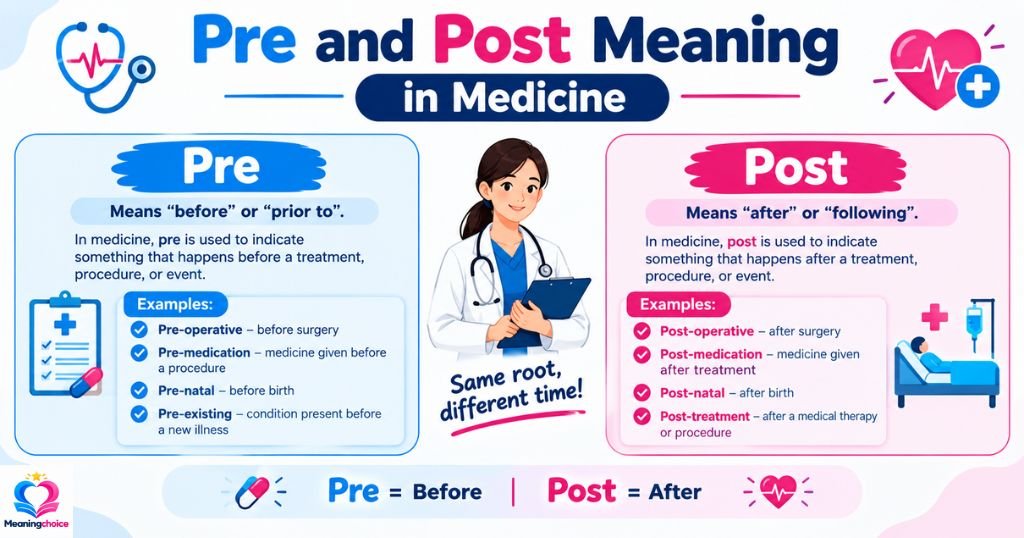
In medical terminology, “pre” signifies before, while “post” indicates after. The preoperative phase refers to the time leading up to a surgical procedure. During this period, healthcare providers may conduct assessments to evaluate the patient’s health and medical history
These can include physical examinations, medical history reviews, and necessary consultations with specialists. This thorough preparation aims to ensure that both patients and medical teams are as informed as possible.
Examples of Pre in Medicine
- Preoperative: Care or instructions given before surgery.
- Prenatal: Care for a mother before birth.
- Pre-existing condition: A health condition that existed before treatment or insurance coverage.
Examples of Post in Medicine
- Postoperative: Care or monitoring after surgery.
- Postnatal: Care for a mother or baby after birth.
- Post-treatment: Observations and tests conducted after therapy or medication.
Pre and Post Meaning in Technology
In the tech world, the terms “pre” and “post” help clarify when certain actions take place.
Pre: This prefix means something happens before a specific event or process. For example, pre-installed software is software that comes installed on a device before it reaches the user. Similarly, prefetching is the process of loading data ahead of time to improve efficiency during access.
Post: Conversely, “post” indicates something that occurs after an event. Post-processing refers to actions taken after the primary processing stage, often to enhance or finalize results. Another example is postback, which describes when a web page sends data back to the server after a user action, like a form submission.
Understanding these distinctions is important for grasping how different technologies operate, providing a clearer insight into system functionality and data handling.
Pre Examples in Social Media
- Pre-scheduled posts: Pre-scheduled posts are created or prepared before their intended publishing time. Social media managers can schedule content in advance so it is automatically published at a selected date and time.
- Pre-event teasers: Pre-event teasers are short posts, videos, or images shared before an event to create interest and encourage people to attend or follow it.
- Pre-launch content: Pre-launch content is published before a product, service, website, or campaign officially launches. It may include announcements, sneak peeks, countdowns, or behind-the-scenes content.
Post Examples in Social Media
- Post-campaign analysis: A post-campaign analysis reviews the results after a social media campaign has ended. Businesses may examine reach, engagement, clicks, conversions, and other available metrics.
- Post-event highlights: Post-event highlights are photos, videos, quotes, or short summaries shared after an event to show followers what happened.
- Post-launch content: Post-launch content is published after a product, service, or campaign has officially launched. It may include customer reactions, tutorials, updates, or additional promotional material.
Also Read: WTD Meaning in Chat, Texting & Social Media: What Does WTD Mean?
Key Differences Between Pre and Post
| Feature | Pre | Post |
| Meaning | Before / prior to | After / following |
| Time Relation | Earlier in time | Later in time |
| Examples | Preheat, Prepay, Preview | Postpone, Postmortem, Postgraduate |
| Usage | Reaction/follow-up | Reaction/follow-up |
Common Misunderstandings About Pre and Post
The term “pre” signifies “before” and is commonly used in both medical and business contexts. In the medical field, “preoperative” refers to the phase before surgery, where doctors evaluate a patient’s health, review medical history, and conduct necessary tests. This stage can help identify potential risks and assess and prepare the patient for the procedure, emphasizing the importance of thorough preparation.
Final Thought
The terms “pre” and “post” help us understand the timing of events in relation to each other. “Pre” generally signifies something that happens before an event, like a pre-game warm-up or pre-exam study sessions. On the other hand, “post” indicates something that occurs after an event, such as a post-concert review or a post-workout snack.
These prefixes are commonly used in various situations to clarify when something takes place. Recognizing the difference between pre and post can upgrade our understanding of everyday activities.




One Comment